
Labelling Requirements for Health & Safety in Warehouses
In the UK, effective labelling in warehouses is not just a matter of organisation; it is a legal requirement to ensure health and safety. Proper labelling helps prevent accidents, ensures compliance with safety standards, and facilitates efficient warehouse operations. In our latest blog we share some of the main UK legal requirements for warehouse labelling.

For businesses handling stock, materials, and machinery, having a clear, standardised warehouse labelling system is essential both for staff safety and operational efficiency.
Legal Framework
The primary legislation governing safety signs and signals in workplaces, including warehouses, is the Health and Safety (Safety Signs and Signals) Regulations 1996.
These regulations set out the requirements for providing information about hazards, safety procedures, and emergency actions through appropriate signs and labelling. Compliance is enforced under the Health and Safety at Work etc. Act 1974, which obliges employers to ensure the health and safety of their employees and anyone affected by their business activities.
For full details, see Health and Safety (Safety Signs and Signals) Regulations 1996.
The Health and Safety Executive (HSE) also provides guidance specifically aimed at warehouses and storage facilities, emphasising the importance of clear labelling to prevent injuries, support safe handling, and maintain effective operations: Warehousing and Storage: A Guide to Health and Safety.
Key Labelling Requirements for Warehouses
Hazard Identification
Areas containing hazards must be clearly labelled to alert staff. This includes flammable materials, electrical hazards, moving machinery, or areas where forklifts operate. Standardised symbols and colour codes are required to ensure hazards are immediately recognised, reducing the risk of accidents.
Emergency Information
All warehouses should have clear signs marking emergency exits, fire equipment, first aid stations, and muster points. Labels must be visible from a distance and, where appropriate, illuminated or photoluminescent to remain visible in low-light conditions.
Traffic and Pedestrian Routes
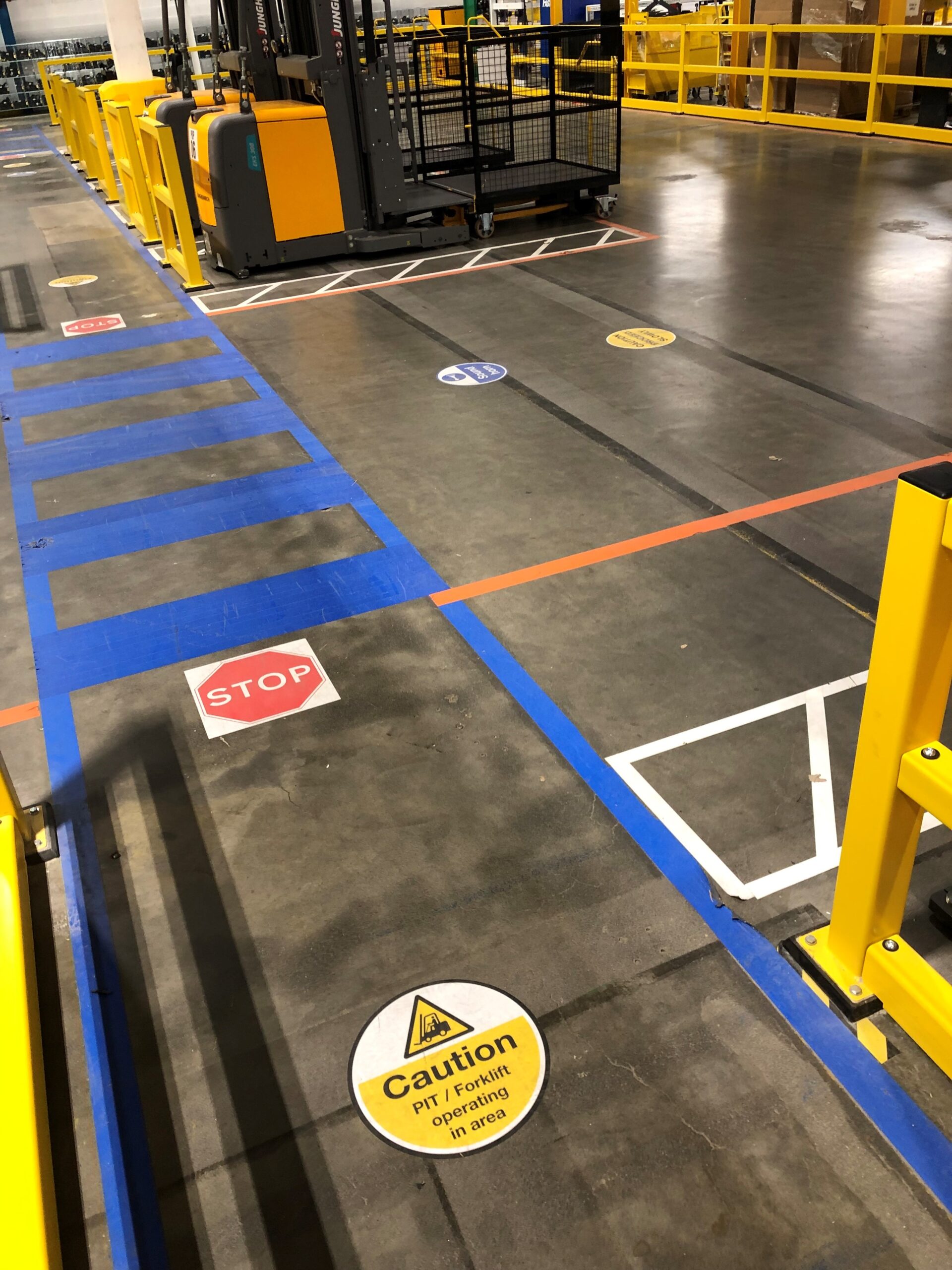
Warehouses often have a mix of foot traffic and moving vehicles such as forklifts or pallet trucks. Routes should be clearly marked, using floor markings and signage, to guide pedestrians and prevent collisions. Areas where staff should not enter should also be clearly indicated.
Storage Instructions
Stock and materials should be labelled to indicate storage requirements, such as “Keep Dry”, “Fragile”, or “Store Upright”. Proper labelling ensures items are handled correctly, preventing damage and reducing the risk of accidents caused by improper storage.
Personal Protective Equipment (PPE) Requirements
Certain areas may require PPE such as gloves, helmets, high-visibility jackets, or safety footwear. These requirements should be clearly communicated through labels at the entrance to the relevant areas.
Chemical and Hazardous Materials Labelling
For warehouses handling chemicals, hazardous materials, or controlled substances, labels must comply with the Classification, Labelling and Packaging (CLP) Regulation. This includes hazard symbols, risk phrases, and precautionary statements. These labels are legally required and crucial for staff safety.
Best Practices for Implementing Labelling
Standardisation
Consistent use of symbols, colour codes, and wording across the warehouse helps prevent confusion.
Visibility
Labels should be positioned at eye level (where appropriate) and kept unobstructed by stock, equipment, or shelving.
Durability
Warehouse environments can be harsh, with dust, moisture, or heat. Labels should be made from robust materials suitable for the application.
Regular Audits
Conduct periodic checks to ensure all labels remain legible and in place. Replace any damaged or faded labels immediately.
Additional Resources
For more guidance on warehouse safety and labelling: